Skip to content
    • info@hktsoft.net
  • Connecting and sharing with us
  • -
  • About us
    • info@hktsoft.net
HKT ConsultantHKT Consultant
  • Management Theories
    • Industrial Organization
      • Competitive Advantage Theory
      • Contingency Theory
      • Institutional Theory
      • Evolutionary Theory of the Firm
      • Theory of Organizational Ecology
      • Behavioral Theory of the Firm
      • Resource Dependence Theory
      • Invisible Hand Theory
    • Managerial Approaches
      • Agency Theory
      • Decision Theory
      • Theory of Organizational Structure
      • Theory of Organizational Power
      • Property Rights Theory
      • The Visible Hand
    • Hypercompetitive Approaches
      • Resource-Based Theory
      • Organizational Learning Theory
      • Transaction Cost Economics
      • Hypercompetition
      • Systems Theory
  • Economic Theories
  • Social Theories
  • Political Theories
  • Philosophies
  • Theology
  • Art Movements
A new 7-S analysis of intel’s secret to success: The new 7-S’s inside

The New 7-S’s can be used to assess competitors, especially to identify their strengths, weaknesses, and use of these factors in the four arenas of competition. Intel Corporation provides an illustration of how a hyper­competitive company uses the New 7-S’s to seize the initiative over and over again. It has drawn upon most, if

28
Aug
Dynamic 7’S analysis: analyzing how competitors seize the initiative from each other

Even if the company is good at using the New 7-S’s, competitors can still seize the initiative, as indicated by the above discussion of the four arenas. Competitors have taken advantage of vulnerabilities of Intel in each of the arenas. They have also used their own strengths in certain S’s or changed the way

28
Aug
New tools for dynamic strategic planning based on the new 7-S’s

As discussed in Part II, approaches to long-term strategic planning that are designed to sustain advantage actually are a poor preparation for long-term success. At best, they prepare companies to win one round of competition. Traditional five-year and ten-year planning models that emphasize sus­tained advantage and planned sequences of milestones and budgets are usually

28
Aug
Loss of the initiative and downward spirals of decline

1. The Downward Spiral With the new analytical tools discussed above, hypercompetitive firms can use the New 7-S’s to seize the initiative. When a company using the New 7-S’s seizes the initiative, its competitor suffers a parallel loss of the initiative. Just as repeatedly seizing the initiative leads to a cycle of mo-mentum, repeated

28
Aug
Sustaining the unsustainable by using the new 7-S’s

Ultimately, knowledge of how to use the New 7-S’s to disrupt the status quo and seize the initiative with a series of unsustainable advantages may be the only source of advantage that is sustained over time. Through using the New 7-S’s to establish a series of temporary advantages, companies build a sustained advantage. This

28
Aug
Two competing American approaches to strategy

There are two competing American approaches to competitive strategy. On the one hand is the collusion-based approach. According to this view, companies sustain advantages by using entry barriers and building explicit or implicit agreements with competitors. On the other hand is all-out war. Under this view, companies sustain their leadership through a dynamic movement

28
Aug
An old tradition returns-with a twist

The current drive to return to cooperation may be the last gasp of diehard adherents of sustainable advantage and traditional collusion-based strat­egy. If they cannot cooperate tacitly, they attempt to cooperate openly. If they cannot sustain their advantages by ordinary means, they try to do so by the extraordinary means of neutralizing the competition

28
Aug
Hypercompetition: A new ideology of competition

Markets were never really static; they just moved to higher levels of com­petition so slowly that they appeared to be static. But today markets are driven by the forces of global information processing and technological competitions that have transformed relatively low-intensity static envi­ronments to high-intensity dynamic hypercompetition overnight. These forces create opportunities to unseat

28
Aug
Hypercompetitive nations

In hypercompetition the advantages of nations are just as unsustainable as the advantages of companies. The past success of U.S. companies in world markets is no guarantee of their future success, as the rise of strong com­petitors from Europe and Asia has demonstrated. Nor is Japan’s success any indication of its future prospects; it

28
Aug
Antitrust policy and the need for a fundamental shift in American ideology

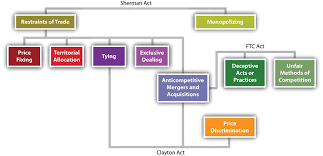
Traditional antitrust laws were created to respond to the needs of the old realities of competition. They are based on the assumption that mar­kets are static and companies can build sustainable advantages that result in monopolies or quasi monopolies. Antitrust laws were also designed to counter the power of large corporations that sought to

28
Aug
The obsolescence of antitrust

Antitrust laws were originally designed as a counterweight to the power of large corporations. These laws leveled the playing field for the “little guy”: customers and small competitors. They were supposed to prevent monop­olies, collusion and price fixing, predation, and exclusionary practices. These laws were created in a time of robber barons. But now,

28
Aug
The dynamic efficiency and fairness of hypercompetition

A group of economists who testified for IBM commented that a key weak­ness of the government’s economic analysis in the case was that it was based on a static view of the world. [One] underlying error that the government’s economic analysis committed was to suppose that a dynamically changing competitive market whose basic feature

28
Aug
Antitrust laws have a negative effect on hypercompetition

Traditional antitrust laws chill and dampen the aggressive competition necessary to achieve the four types of dynamic efficiency in hypercompeti­tion. When firms are very successful at racing up the escalation ladders, they are, ironically, vulnerable to allegations of being anticompetitive. In hypercompetition companies often do things that might be interpre­ted as anticompetitive under antitrust

28
Aug
The uncertain future of antitrust: What is needed

Fortunately, most hypercompetitive firms never run afoul of the antitrust laws. In fact, recent court decisions have increasingly recognized the real­ities of hypercompetition. The courts have eased restrictions on competi­tion on price and quality (arena 1 competition). The decision in favor of American Airlines and a ruling in the cigarette industry have made pred­atory

28
Aug
Some theoretical antecedents of resource-based theory

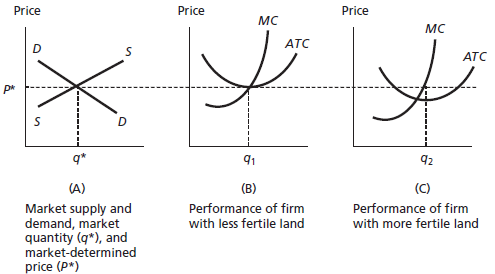
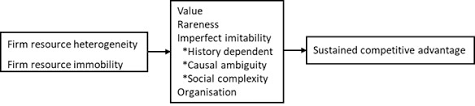
Resource-based theory, like any theory, draws on prior theoretical work in developing its predictions and prescriptions. In the case of resource- based theory, important prior theoretical work comes from at least four sources: (a) the traditional study of distinctive competencies, (b) Ricardo’s analysis of land rents, (c ) Penrose (1959), and (d) the study


29
Aug
The development of resource-based theory

1. EARLY RESOURCE-BASED CONTRIBUTIONS1 Perhaps the first resource-based theory publication in the field of strate- gic management identified as such was by Wernerfelt (1984). Ironically, Wernerfelt’s resource-based arguments did not grow directly from any of the four theoretical traditions identified above. Rather, Wernerfelt’s argu- ment is an example of dualistic reasoning common in economics.

29
Aug
Parallel streams of ‘resource-based’ work

As this resource-based theory was developing, scholars in other research traditions were developing theories of competitive advantage that had numerous similarities to resource-based logic but were developed largely independent of the work cited earlier. Two of the most important of these parallel streams were the theory of invisible assets (Itami 1987), and work on

29
Aug
Additional comments about resource-based theory

Before continuing this discussion, a few additional comments about resource-based theory are needed. These concern the confusion about terms describing factors of production controlled by a firm and the definition of competitive advantage in resource-based theory. These clari- fications will greatly simplify the discussion in the remainder of this book. 1. TERMS TO DESCRIBE

29
Aug
Perfect strategic factor market competition

When firms seeking to develop resources to implement a strategy (strate- gizers) and those who currently own or control these resources (con- trollers) have exactly the same, and perfectly accurate, expectations about the future value of product market strategies before they are actually imple- mented, then the price of the resources needed to conceive

29
Aug
Heterogeneous expectations in strategic factor markets

These perfect competition dynamics, and the zero economic rents from implementing strategies they imply, depend, of course, on the very strong assumption that all strategizers and controllers have the same, and perfectly accurate, expectations concerning the future value of strategies. This is a condition that is not likely to exist very often in real

29
Aug
  • 1
  • …
  • 203
  • 204
  • 205
  • 206
  • 207
  • 208
  • 209
  • …
  • 212
List of Great Thinkers
01
Jan
List of Economic Theories and Concepts
24
Feb
List of Social Theories and Concepts
22
Feb
List of Political Theories and Concepts
21
Feb
List of Philosophical Theories and Concepts
22
Feb
Famous books and articles in library
01
Jan
Corporate Management
  • International Business – Meaning, Process, Types & FactorsInternational Business – Meaning, Process, Types & Factors
  • Marketing and Corporate BrandingMarketing and Corporate Branding
  • Human Resource Management and Organizational CultureHuman Resource Management and Organizational Culture
  • Entrepreneurship and StartupEntrepreneurship and Startup
  • Corporate accounting: definition, functions and branchesCorporate accounting: definition, functions and branches
  • Firm Strategy and Strategic ManagementFirm Strategy and Strategic Management

Methodology & Skills
  • Create your professional WordPress website without codeCreate your professional WordPress website without code
  • Qualitative Research (interview, case study, observation, action research …)Qualitative Research (interview, case study, observation, action research …)
  • Research MethodologyResearch Methodology
  • Learn Programming Languages (JavaScript, Python, Java, PHP, C, C#, C++, HTML, CSS)Learn Programming Languages (JavaScript, Python, Java, PHP, C, C#, C++, HTML, CSS)
  • How to write a thesisHow to write a thesis
  • How to write and publish a scientific paperHow to write and publish a scientific paper

Connecting and sharing with us

... by your free and real actions.

hotlineTComment and discuss your ideas

Enthusiastic to comment and discuss the articles, videos on our website by sharing your knowledge and experiences.

hỗ trợ hkt Respect the copyright

Updating and sharing our articles and videos with sources from our channel.

hỗ trợ hkt Subscribe and like our articles and videos

Supporting us mentally and with your free and real actions on our channel.

HKT Channel - Science Theories

About HKT CHANNEL
About HKT CONSULTANT

Website Structure

Economic Theories
Social Theories
Political Theories
Great Thinkers
Library

HKT Consultant JSC.

      "Knowledge - Experience - Success"
- Email: Info@hktsoft.net
- Website:
sciencetheory.net

  • Management Theories
    • Industrial Organization
      • Competitive Advantage Theory
      • Contingency Theory
      • Institutional Theory
      • Evolutionary Theory of the Firm
      • Theory of Organizational Ecology
      • Behavioral Theory of the Firm
      • Resource Dependence Theory
      • Invisible Hand Theory
    • Managerial Approaches
      • Agency Theory
      • Decision Theory
      • Theory of Organizational Structure
      • Theory of Organizational Power
      • Property Rights Theory
      • The Visible Hand
    • Hypercompetitive Approaches
      • Resource-Based Theory
      • Organizational Learning Theory
      • Transaction Cost Economics
      • Hypercompetition
      • Systems Theory
  • Economic Theories
  • Social Theories
  • Political Theories
  • Philosophies
  • Theology
  • Art Movements
  • About Us