Skip to content
    • info@hktsoft.net
  • Connecting and sharing with us
  • -
  • About us
    • info@hktsoft.net
HKT ConsultantHKT Consultant
  • Management Theories
    • Industrial Organization
      • Competitive Advantage Theory
      • Contingency Theory
      • Institutional Theory
      • Evolutionary Theory of the Firm
      • Theory of Organizational Ecology
      • Behavioral Theory of the Firm
      • Resource Dependence Theory
      • Invisible Hand Theory
    • Managerial Approaches
      • Agency Theory
      • Decision Theory
      • Theory of Organizational Structure
      • Theory of Organizational Power
      • Property Rights Theory
      • The Visible Hand
    • Hypercompetitive Approaches
      • Resource-Based Theory
      • Organizational Learning Theory
      • Transaction Cost Economics
      • Hypercompetition
      • Systems Theory
  • Economic Theories
  • Social Theories
  • Political Theories
  • Philosophies
  • Theology
  • Art Movements
Other apparent competitive imperfections: the question of tradability

Firms with consistently more accurate expectations concerning the value- creating potential of strategies they are implementing can expect to enjoy competitive advantages from implementing their strategies over the long run. In this sense, differences in firm expectations constitute a strategic factor market competitive imperfection. Some have suggested that other differences between firms, besides dif-

29
Aug
Developing insights into strategic value

Thus far, it has been argued that, in perfectly competitive strategic factor markets, the cost of the resources necessary to implement a strategy will approximately equal the discounted present value of that strategy once it is implemented. It has also been argued that competitive imperfections in this market can give firms opportunities for obtaining

29
Aug
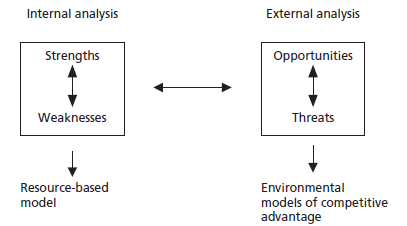
Firm resource approach in strategic management

Chapter 1 of this book defined and developed the strategic management question—Why do some firms outperform other firms?—and described the evolution of resource-based theory as one approach to answering this question. Chapter 2 introduced the concept of a strategic factor market to demonstrate that whether a firm gains competitive advantages does not depend just

29
Aug
Competitive advantage and sustained competitive advantage

The concept of competitive advantage was defined in Chapter 1. There, it was suggested that a firm has a competitive advantage when it is able to create more economic value than the marginal firm in its industry. How- ever, as important as it is to explain the existence of competitive advantages among firms, the

29
Aug
Competition with homogeneous and perfectly mobile resources

Armed with a definition of sustained competitive advantage, it is now possible to explore the impact of resource heterogeneity and immobility on this concept. This is done by first examining the possibility of sustained competitive advantage when firm resources are perfectly homogeneous and mobile. Then, the possibility of sustained competitive advantage under heterogeneity and

29
Aug
Firm resources and sustained competitive advantage

Thus far, it has been suggested that in order to understand sources of sustained competitive advantage, it is necessary to build a theoretical model that begins with the assumption that firm resources may be heterogeneous and immobile. Of course, not all firm resources hold the potential of sustained competitive advantages. To have this potential,

29
Aug
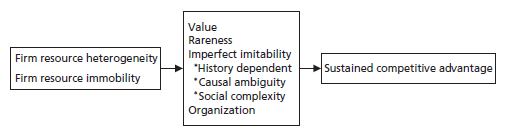
A framework for resource-based analysis: VRIO

The relationship between resource heterogeneity and immobility; value, rarity, imitability, and organization; and sustained competitive advantage is summarized in Figure 3.2. This has been developed into a frame- work that can be applied in analyzing the potential of a broad range of firm resources to be sources of sustained competitive advantage. These analyses not

29
Aug
VRIO framework Discussion

This VRIO framework suggests the kinds of questions that need to be addressed in order to understand whether a particular firm resource is a source of sustained competitive advantage: Is that resource valuable?, Is it rare?, Is it imperfectly imitable?, and Is the firm organized to exploit this resource? This framework is applied to

29
Aug
Defining culture and competitive advantage

Few concepts in organizational theory have as many different and compet- ing definitions as ‘organizational culture’. Smircich (1983), for example, has cited five classes of such definitions in her literature review. Rather than attempt to resolve these numerous and subtle definitional conflicts, a definition that is consistent with most of the research about organizational

29
Aug
Culture and sustained superior financial performance

In order for a firm’s culture to provide sustained competitive advantages, three conditions must be met (Barney 1991a). First, the culture must be valuable; it must enable a firm to do things and behave in ways that lead to high sales, low costs, high margins, or in other ways create economic value to the

29
Aug
Competitive advantage from organizational culture

If a firm’s culture, in order to be the source of sustained competitive advan- tages, must be valuable, rare, and imperfectly imitable, then the possibility that organizational cultures with these characteristics exist must be eval- uated. Previous research on organizational cultures suggests that at least some cultures of some firms have these characteristics, and

29
Aug
Normative implications of culture research

These arguments have a variety of normative implications, both for man- agers in firms without valuable cultures and for managers in firms with valuable cultures. 1. FIRMS WITHOUT VALUABLE CULTURES For firms without valuable cultures, the normative implications of these analyses are somewhat limiting. Such firms cannot expect to obtain even temporary competitive advantages

29
Aug
Defining trust and trustworthiness

Numerous definitions of trust and trustworthiness have been presented in the literature (Gambetta 1988; Bradach and Eccles 1989; Lewicki and Bunker 1994). For purposes of this chapter, Sabel’s definition of trust (1993: 1133) has been adopted: trust is the mutual confidence that no party to an exchange will exploit another’s vulnerabilities. Parties to an

29
Aug
Types of trust

While trust is the mutual confidence that one’s vulnerabilities will not be exploited in an exchange, different types of trust can exist in different eco- nomic exchanges. These different types of trust depend on different reasons parties to an exchange can have the confidence that their vulnerabilities will not be exploited. At least three

29
Aug
Trust and competitive advantage

Trust can emerge in economic exchanges in any of the three ways discussed. However, these three types of trust are not equally likely to be sources of competitive advantage. A strategic analysis of trust and trustworthiness focuses on the conditions under which a particular type of trust will be a source of competitive advantage.

29
Aug
Discussion on Trust as a source of sustained competitive advantage

Trust, in economic exchanges, can be a source of competitive advantage. However, trust in these exchanges is not always a source of competi- tive advantage. Weak form trust is only a competitive advantage when competitors invest in unnecessary and costly semi-strong governance mechanisms. Semi-strong form trust is only a source of competitive advan- tage when

29
Aug
Resource-based analysis of human resources

1. THE ECONOMIC VALUE OF HUMAN RESOURCES Firms create value by either decreasing product/service costs or differenti- ating the product/service in a way that allows the firm to charge a premium price. Thus, the ultimate goal of any HR executive is to create value through the HR function. The first question that an HR

30
Aug
Human resources and sustainable competitive advantage

The VRIO analysis above illustrates how a variety of firms have attempted to develop their human resources to provide sources of sustainable com- petitive advantage. The VRIO framework (summarized in Table 3.1) pro- vides a tool to assist managers to evaluate the potential for specific firm resources to be sources of competitive disadvantage, competitive

30
Aug
Implications of Resource-based theory for HR executives

This resource-based analysis has a number of implications for HR execu- tives. In general, it highlights the fact that HR executives play an important role in managing the firm’s human assets, those that possess the great- est potential for being sources of sustained competitive advantage. More specifically, it provides guidance regarding the management of

30
Aug
The value of Information technology

Traditionally, most research in strategic IT has focused on the ability of IT to add economic value to a firm by either reducing a firm’s costs or differentiating its products or services (see McFarlan 1984; Porter and Millar 1985; Bakos and Treacy 1986; Wiseman 1988). For example, when Wal-Mart adopted its purchase–inventory–distribution system, it

30
Aug
  • 1
  • …
  • 204
  • 205
  • 206
  • 207
  • 208
  • 209
  • 210
  • …
  • 212
List of Great Thinkers
01
Jan
List of Economic Theories and Concepts
24
Feb
List of Social Theories and Concepts
22
Feb
List of Political Theories and Concepts
21
Feb
List of Philosophical Theories and Concepts
22
Feb
Famous books and articles in library
01
Jan
Corporate Management
  • Office Management: definition, types, process, jobs and best practicesOffice Management: definition, types, process, jobs and best practices
  • Logistics Management: meaning, functions, importance, process and best practicesLogistics Management: meaning, functions, importance, process and best practices
  • Production Management : Definition, Function and ScopeProduction Management : Definition, Function and Scope
  • Marketing and Corporate BrandingMarketing and Corporate Branding
  • Firm Strategy and Strategic ManagementFirm Strategy and Strategic Management
  • Management Information SystemManagement Information System

Methodology & Skills
  • Research MethodologyResearch Methodology
  • Quantitative research and Statistical software practices (SPSS, Stata, Amos, …)Quantitative research and Statistical software practices (SPSS, Stata, Amos, …)
  • Learn Programming Languages (JavaScript, Python, Java, PHP, C, C#, C++, HTML, CSS)Learn Programming Languages (JavaScript, Python, Java, PHP, C, C#, C++, HTML, CSS)
  • Qualitative Research (interview, case study, observation, action research …)Qualitative Research (interview, case study, observation, action research …)
  • How to write a thesisHow to write a thesis
  • How to write and publish a scientific paperHow to write and publish a scientific paper

Connecting and sharing with us

... by your free and real actions.

hotlineTComment and discuss your ideas

Enthusiastic to comment and discuss the articles, videos on our website by sharing your knowledge and experiences.

hỗ trợ hkt Respect the copyright

Updating and sharing our articles and videos with sources from our channel.

hỗ trợ hkt Subscribe and like our articles and videos

Supporting us mentally and with your free and real actions on our channel.

HKT Channel - Science Theories

About HKT CHANNEL
About HKT CONSULTANT

Website Structure

Economic Theories
Social Theories
Political Theories
Great Thinkers
Library

HKT Consultant JSC.

      "Knowledge - Experience - Success"
- Email: Info@hktsoft.net
- Website:
sciencetheory.net

  • Management Theories
    • Industrial Organization
      • Competitive Advantage Theory
      • Contingency Theory
      • Institutional Theory
      • Evolutionary Theory of the Firm
      • Theory of Organizational Ecology
      • Behavioral Theory of the Firm
      • Resource Dependence Theory
      • Invisible Hand Theory
    • Managerial Approaches
      • Agency Theory
      • Decision Theory
      • Theory of Organizational Structure
      • Theory of Organizational Power
      • Property Rights Theory
      • The Visible Hand
    • Hypercompetitive Approaches
      • Resource-Based Theory
      • Organizational Learning Theory
      • Transaction Cost Economics
      • Hypercompetition
      • Systems Theory
  • Economic Theories
  • Social Theories
  • Political Theories
  • Philosophies
  • Theology
  • Art Movements
  • About Us