Skip to content
    • info@hktsoft.net
  • Connecting and sharing with us
  • -
  • About us
    • info@hktsoft.net
HKT ConsultantHKT Consultant
  • Management Theories
    • Industrial Organization
      • Competitive Advantage Theory
      • Contingency Theory
      • Institutional Theory
      • Evolutionary Theory of the Firm
      • Theory of Organizational Ecology
      • Behavioral Theory of the Firm
      • Resource Dependence Theory
      • Invisible Hand Theory
    • Managerial Approaches
      • Agency Theory
      • Decision Theory
      • Theory of Organizational Structure
      • Theory of Organizational Power
      • Property Rights Theory
      • The Visible Hand
    • Hypercompetitive Approaches
      • Resource-Based Theory
      • Organizational Learning Theory
      • Transaction Cost Economics
      • Hypercompetition
      • Systems Theory
  • Economic Theories
  • Social Theories
  • Political Theories
  • Philosophies
  • Theology
  • Art Movements
Seizing Opportunities

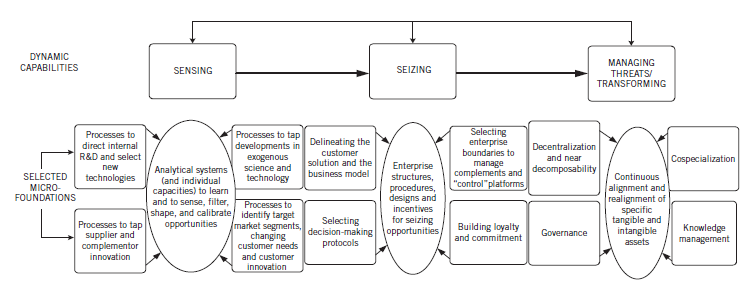
Nature of the Capability Once a  new  (technological  or  market)  opportunity  is  sensed, it must be addressed through new products,  processes,  or  ser- vices. This almost always  requires  investments  in  development and commercialization activity. Multiple (competing) investment paths are possible, at least early on. The quintessential example is the automobile industry, where in the

31
Aug
Microfoundations

1. Selecting Product Architectures and Business Models  The design and performance specification of products, and the business model employed, all help define the manner by which the enterprise delivers value to customers, entices customers to pay for value, and converts those payments to profit. They reflect management’s hypothesis about what customers  want and how

31
Aug
Managing Threats and Reconfiguration

1. Nature  The successful identification and calibration of technological and market opportunities, the judicious selection of technologies and product attributes, the design of business models, and the com- mitment of (financial) resources to investment opportunities can lead to enterprise growth and profitability. Profitable growth will lead to the augmentation of enterprise-level resources and assets.

31
Aug
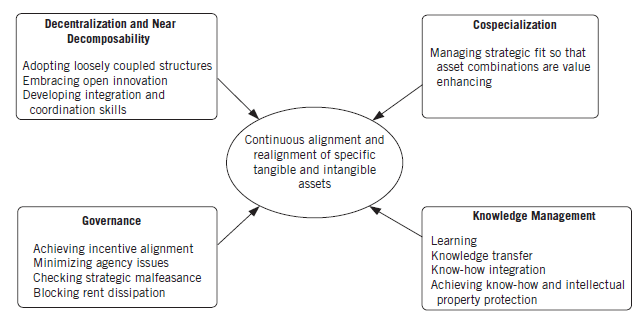
Microfoundations

1. Achieving Decentralization and Near Decomposability  Every system comprises subsystems (elements) that are to some extent interdependent and independent. However, as discussed earlier, enterprises are unlikely  to  be  continuously  responsive to customers and new technologies absent a high degree of decentralization. With decentralized decision making, different managers observe different information and control different deci-

31
Aug
Dynamic Capabilities, “Orchestration” Skills, and Competitive Advantage

The general framework advanced here sees dynamic capabilities as the foundation of enterprise-level competitive advantage in regimes of rapid (technological) change. The framework indicates that the extent to which an enterprise develops and employs superior (nonimitable) dynamic capabilities will determine the nature and amount of intangible assets it will create and/or assemble and the

31
Aug
Resources/Competences Distinguished from Dynamic Capabilities

The dynamic capabilities framework advances a neo-Schum- peterian theory of the firm and organizational decision making that is recognizable to those familiar with the behavioral theory of the firm, with evolutionary theorizing in economics, and with a Schumpeterian characterization of the innovation process. It also builds on what has come to be known as

31
Aug
Introduction

The concept of dynamic capabilities highlights  organizational and managerial competences. Key ingredients of dynamic capa- bilities include organizational processes directed toward learn- ing and innovation, the basic manner in which a business is designed, as well as the decision frames and heuristics  that inform firms’ investment choices over time. Once assets come within the

31
Aug
Understanding the Fundamental Economic Problems “Solved” by Management

It is an understatement to say that economic theory underplays the role of the manager; in fact, the strategic manager simply does not exist in any recognizable form. True, shareholders appoint agents (managers) to stewardship roles in the enterprise, but eco- nomic theory says little about what executives actually do and the economic function,

31
Aug
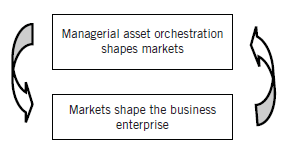
Definition and nature of Asset Orchestration

  1. Asset Orchestration (in the Face of Thin Markets) In early management scholarship, Chester Barnard and others stressed the role of management in limiting conflict and effec- tuating cooperation inside the firm. Barnard saw formal orga-nization and the business firm as a system of consciously coordinated activities of two or more persons. In

31
Aug
Asset Orchestration versus Coordination and Adaptation

Coordination as an economic problem is only necessary because of change (Hayek, 1945). In a static environment, a short period of “set up” would be required to organize economic activity; but absent change in consumer tastes or technology, economic agents (both traders and managers) would sort out the optimal flows of goods and services

31
Aug
Toward a Dynamic Capabilities (Economic) Theory of the Firm

Ronald Coase in his classic (1937) article on the nature of the firm described firms and markets as alternative modes of governance, the choice between them made so as to minimize transaction costs. The boundaries of the firm were set by bringing transactions into the firms so that at the margin the internal costs

31
Aug
Introduction

This chapter begins with some notes on the development of stra- tegic management concepts in general, and the dynamic capabil- ities framework in particular. The dynamic capabilities framework draws from many intellectual streams, including entrepreneurship, the behavioral theory of the firm and behavioral decision the- ory, organization theory, transaction cost economics, and to some


31
Aug
The Foundations of Dynamic Capabilities: Strategic Management

The focus of the field of strategic management is on choices with respect to the direction of the evolution of the business enterprise. It covers subjects of primary concern to senior executives, and to anyone interested in the success and failure of the business enterprise. The field is grounded in practice and exists because

31
Aug
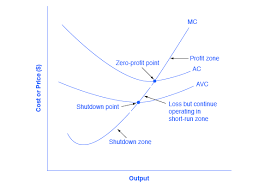
The Foundations of Dynamic Capabilities: Escaping the Zero-Profit Condition

The economic theory of (perfect) competition explains that in “equilibrium” firms will make only just enough to cover their cost of capital. This is sometimes referred to as the zero-profit condition. It occurs in the model because there are no points of differentiation amongst firms with respect to technology, markets, information, or skills. With

31
Aug
Dynamic Capabilities Defined

As discussed in Chapter 1, dynamic capabilities refer to the par- ticular (nonimitability) capacity business enterprises possess to shape, reshape, configure, and reconfigure assets so as to respond to changing technologies and markets and escape the zero-profit condition. Dynamic capabilities relate to the enterprise’s ability to sense, seize, and adapt in order to generate

31
Aug
Dynamics Capabilities as a Theory of Entrepreneurial Management

We now return to the dynamic capabilities perspective which builds on ideas from all of the above traditions. In addition to syn- thesizing ideas from different theoretical traditions, the dynamic capabilities approach seeks to provide a coherent framework which can both integrate existing conceptual and empirical knowledge, and facilitate prescription. First published in Teece

31
Aug
Implications of Dynamics Capabilities for Future Research on the Firm, the Role of the Manager, and Ecosystems

Based on the discussion of the intellectual roots and current con- tent of the dynamic capabilities research program, we can outline at least the following important implications for research on strategic processes and organizational change. 1. Finding a Place for the Manager in Economic Theory Ronald Coase was well aware that economists have neglected

31
Aug
Strategy as Evolution with Design

In 1978, Ronald Coase wrote in a comment in the American Eco- nomic Review: “The IQ of Natural Selection is zero. The IQ of busi- nessmen and politicians may not be too high but it is not zero.” While Coase was referring to the debate about the role of natural section versus intentionality in

31
Aug
Introduction

Edith Penrose’s many and varied contributions to business studies deserve recognition. In her later years, she focused on the oil industry and on multinational enterprises (MNEs).1 In this chapter, we note some of her earlier contributions which helped initiate important streams of research, including the resource-based theory of the firm. Her influence has also

31
Aug
The Resource-Based Theory of the Firm

Penrose defined the internal resources of the firm as “the pro- ductive services available to a firm from its own resources, par- ticularly the productive services available from management with experience within the firm” (p. 5). She presents the firm as an “autonomous administrative planning unit, the activities of which are interrelated and are

31
Aug
  • 1
  • …
  • 206
  • 207
  • 208
  • 209
  • 210
  • 211
  • 212
List of Great Thinkers
01
Jan
List of Economic Theories and Concepts
24
Feb
List of Social Theories and Concepts
22
Feb
List of Political Theories and Concepts
21
Feb
List of Philosophical Theories and Concepts
22
Feb
Famous books and articles in library
01
Jan
Corporate Management
  • Corporate accounting: definition, functions and branchesCorporate accounting: definition, functions and branches
  • Stock market: functioning and investmentsStock market: functioning and investments
  • Supply Chain and Supply Chain ManagementSupply Chain and Supply Chain Management
  • What is Corporate Finance? Fundamentals, Principles and FeaturesWhat is Corporate Finance? Fundamentals, Principles and Features
  • Logistics Management: meaning, functions, importance, process and best practicesLogistics Management: meaning, functions, importance, process and best practices
  • Quality Management – Understanding how does it improve firm performanceQuality Management – Understanding how does it improve firm performance

Methodology & Skills
  • Learn Programming Languages (JavaScript, Python, Java, PHP, C, C#, C++, HTML, CSS)Learn Programming Languages (JavaScript, Python, Java, PHP, C, C#, C++, HTML, CSS)
  • Quantitative research and Statistical software practices (SPSS, Stata, Amos, …)Quantitative research and Statistical software practices (SPSS, Stata, Amos, …)
  • How to write and publish a scientific paperHow to write and publish a scientific paper
  • Qualitative Research (interview, case study, observation, action research …)Qualitative Research (interview, case study, observation, action research …)
  • Research MethodologyResearch Methodology
  • How to write a thesisHow to write a thesis

Connecting and sharing with us

... by your free and real actions.

hotlineTComment and discuss your ideas

Enthusiastic to comment and discuss the articles, videos on our website by sharing your knowledge and experiences.

hỗ trợ hkt Respect the copyright

Updating and sharing our articles and videos with sources from our channel.

hỗ trợ hkt Subscribe and like our articles and videos

Supporting us mentally and with your free and real actions on our channel.

HKT Channel - Science Theories

About HKT CHANNEL
About HKT CONSULTANT

Website Structure

Economic Theories
Social Theories
Political Theories
Great Thinkers
Library

HKT Consultant JSC.

      "Knowledge - Experience - Success"
- Email: Info@hktsoft.net
- Website:
sciencetheory.net

  • Management Theories
    • Industrial Organization
      • Competitive Advantage Theory
      • Contingency Theory
      • Institutional Theory
      • Evolutionary Theory of the Firm
      • Theory of Organizational Ecology
      • Behavioral Theory of the Firm
      • Resource Dependence Theory
      • Invisible Hand Theory
    • Managerial Approaches
      • Agency Theory
      • Decision Theory
      • Theory of Organizational Structure
      • Theory of Organizational Power
      • Property Rights Theory
      • The Visible Hand
    • Hypercompetitive Approaches
      • Resource-Based Theory
      • Organizational Learning Theory
      • Transaction Cost Economics
      • Hypercompetition
      • Systems Theory
  • Economic Theories
  • Social Theories
  • Political Theories
  • Philosophies
  • Theology
  • Art Movements
  • About Us